
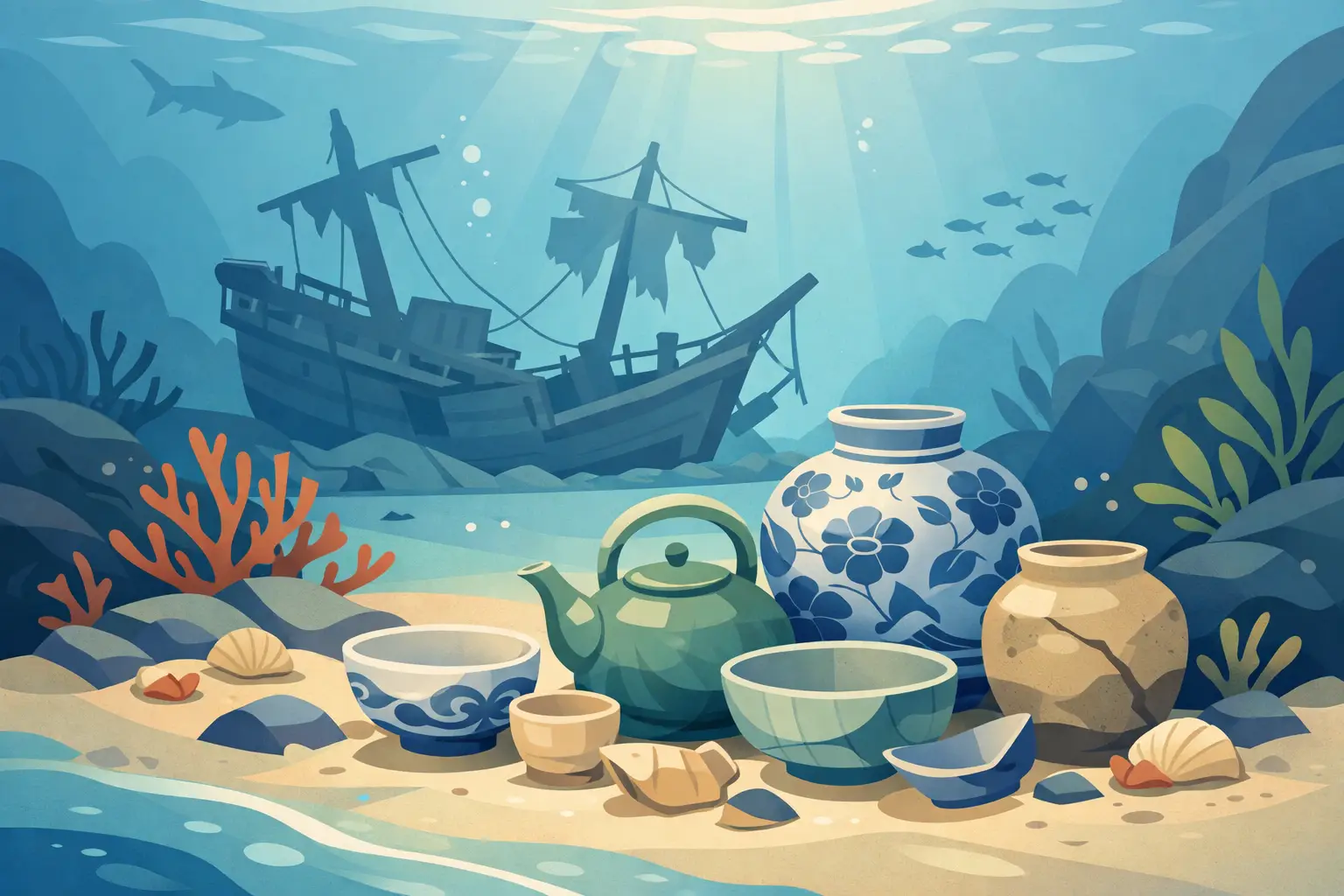

A bowl lifted from the seabed can say more about Asia’s past than a shelf of textbooks. Glaze, clay body, kiln style and even marine encrustation can reveal where it was made, who traded it, and why it was still travelling when disaster struck. That is what makes a guide to Asian shipwreck ceramics so compelling – these are not simply beautiful objects, but time capsules of maritime exchange.
For visitors, collectors and anyone drawn to the poetry of porcelain, shipwreck ceramics offer a rare way to see trade history in its most tangible form. Unlike objects passed neatly through royal collections or family estates, these pieces survived interruption. They were cargo, destined for markets across Southeast Asia and beyond, before storms, reefs, fire or human error sent them to the ocean floor.
Why Asian shipwreck ceramics matter
Asian waters carried some of the busiest trade routes in the world for centuries. Ceramics moved in astonishing volume from the kilns of China, Thailand, Vietnam and other production centres to ports, courts and homes across the region. They were practical wares, diplomatic gifts, prestige items and export goods all at once.
When a ship sank, it froze one moment of that movement. A wreck can show what was being traded in a specific period, what shapes and decorations appealed to buyers, and how commerce connected distant communities. In that sense, shipwreck ceramics sit at the meeting point of art, archaeology and economic history.
They also complicate easy assumptions. A finely painted dish may look imperial, yet have been made for export. A humble storage jar may prove more historically revealing than a decorative plate. Beauty matters, but context matters more.
A guide to Asian shipwreck ceramics begins with context
The first question to ask is not whether a piece is attractive, but what role it played on board. Cargoes were often mixed. Fine blue and white porcelain might sit alongside celadon, brown-glazed stoneware, domestic wares and transport jars. That variety tells us a great deal about intended markets.
Dating usually begins with form, glaze and decoration. The curve of a bowl, the tone of cobalt blue, the texture of the foot rim and the colour of the clay body can all point to a period and kiln tradition. Specialists then compare those clues with excavated examples, known cargoes and documented trade patterns.
Condition is more complex than many first-time viewers expect. Marine burial can preserve ceramics extraordinarily well, but it can also alter surfaces. Salt exposure, coral adhesion, abrasion and mineral deposits are part of a shipwreck object’s story. For some audiences, those marks enhance authenticity. For others, especially collectors who prefer a pristine finish, they may seem like damage. Neither response is entirely wrong – it depends whether one values archaeological integrity, decorative perfection or both.
What to look for in shipwreck porcelain and stoneware
The most immediate features are usually shape and decoration. Open bowls, covered boxes, kendi, dishes, ewers and jars each suggest different uses and markets. Export wares were often designed with portability and stackability in mind, which is why repeated forms appear in large quantities across many wrecks.
Decoration offers another layer of reading. Blue and white remains the best-known category, but monochromes, celadons and underglaze iron wares are equally important. Motifs such as scrolling foliage, floral sprays, phoenixes, waves or geometric borders can hint at both date and destination. Some patterns catered to local taste in Southeast Asia rather than domestic Chinese use, reminding us that trade was shaped by demand, not simply by production.
Then there is the body itself. Porcelain, stoneware and earthenware each behave differently in firing and in marine environments. A dense porcelain body with a clean ring may feel very different from a heavier utilitarian jar. Learning to distinguish them sharpens the eye quickly.
Marks can help, though they should never be treated as the whole answer. Reign marks, potters’ marks and symbols may be genuine, apocryphal or purely decorative. In export ceramics, marks sometimes imitate higher-status wares. That is why specialists read them alongside paste, glaze and form, rather than in isolation.
The stories hidden in well-known wreck cargoes
Some of the most fascinating shipwreck groups in Asia are remarkable because they capture distinct trade moments. A cargo associated with the Wanli period, for example, speaks to the global appetite for late Ming export porcelain and the sophistication of maritime commerce at the time. Pieces from such cargoes often show confident brushwork, commercial scale and an adaptability that made Chinese ceramics enormously successful abroad.
Other wrecks tell a more regional story. Thai and Vietnamese ceramics found in Southeast Asian waters reveal how active intra-Asian exchange was, quite apart from later European narratives of trade. Their forms can be restrained, practical and elegant, and their importance lies not only in rarity but in the networks they map.
Ship names often become shorthand for entire ceramic assemblages – the Turiang, Royal Nanhai, Nanyang, Xuande and Desaru among them. Yet a wreck is never only a list of objects. It is a record of route, risk and intention. The most meaningful way to view these ceramics is not as isolated treasures, but as parts of one interrupted journey.
How museums help you read shipwreck ceramics properly
Photographs can capture colour and pattern, but they rarely convey scale, weight or surface. Seeing recovered ceramics in person changes the experience. You notice stacking marks, firing flaws, glaze pooling and tiny inconsistencies that mass-produced modern wares have taught us to overlook.
That is where thoughtful curation becomes invaluable. A well-presented collection does more than display porcelain attractively. It places objects within shipping history, production traditions and the human drama of maritime loss. For families and first-time visitors, this makes a complex subject accessible. For seasoned enthusiasts, it offers the pleasure of comparison and closer study.
At Straits & Oriental Museum, this encounter is especially rewarding because the setting treats maritime heritage as a living cultural experience rather than a sealed academic subject. Authentic ceramics recovered from notable Asian shipwrecks are presented within a broader environment of art, hospitality and storytelling, allowing visitors to move from historical reflection to leisurely conversation without losing the sense of place.
Collecting and authenticity – what deserves caution
Interest in shipwreck ceramics often begins with admiration and then moves towards collecting. That can be deeply rewarding, but it also requires restraint. The market includes authentic recovered pieces, legally released artefacts, later reproductions and decorative wares loosely described as shipwreck-related. These are not the same thing.
Provenance matters enormously. Without clear documentation, a dramatic story about a seabed discovery should be treated carefully. Marine deposits can be imitated, and romantic claims often inflate value. Reputable sourcing, conservation history and expert attribution are more persuasive than a seller’s anecdote.
There is also an ethical dimension. Some collectors value ownership, while others prefer objects to remain in institutions where they can be interpreted publicly. That tension is part of the field. It does not mean private collecting is inherently wrong, but it does mean that informed buyers should understand the legal and archaeological implications attached to recovered material.
Why these ceramics still resonate now
Shipwreck ceramics endure because they satisfy more than one kind of curiosity. They are visually refined, but they are also evidence. They speak to taste, commerce, migration and hazard. They remind us that Asia’s seas were not edges between cultures, but highways binding them together.
For travellers, this can turn a museum visit into something richer than sightseeing. A single dish or jar becomes a way into larger questions: who made it, who bought it, which port awaited it, and what was lost when the ship went down? Those questions linger because they connect the intimacy of an object with the scale of history.
If you are beginning to look closely, do not worry about learning every kiln and dynasty at once. Start with the material presence of the piece itself – its weight, wear, pattern and purpose. The more carefully you look, the more the sea gives back.