
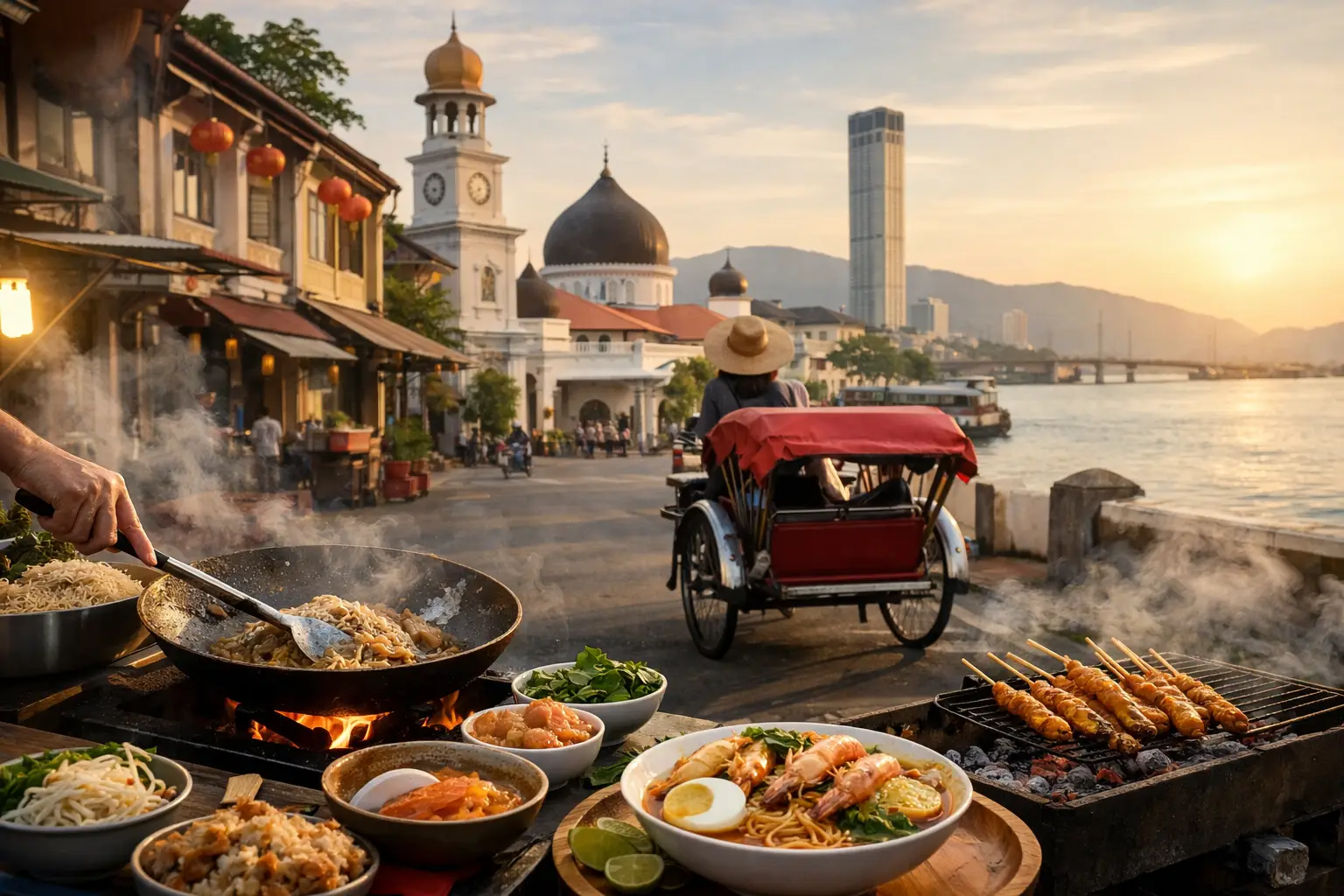

A bowl of assam laksa can begin with the sharp perfume of tamarind and finish with a question about where Penang has been. That is the pleasure of Penang as a food haven: its most memorable dishes are not simply specialities to seek out, but edible records of migration, commerce, faith, family and the sea.
For visitors, this makes every meal an opportunity to read the island differently. A modest hawker stall, a kopitiam with marble-topped tables, a family-run restaurant or a refined dining room may each hold a fragment of the same larger story. Penang’s cuisine has been shaped by the people who arrived at its shores, made lives here and adapted inherited recipes to local ingredients and local tastes.
Penang as a food haven was built by the sea
Penang’s position on historic trading routes is central to its culinary character. For centuries, the Straits of Malacca carried merchants, sailors, labourers and travellers between China, India, the Malay Archipelago and beyond. They brought goods, languages, religious traditions and cooking knowledge with them. The result was not a single, fixed food culture, but an exceptional meeting place of traditions.
Chinese, Malay, Indian and Peranakan influences are immediately recognisable, yet the real distinction lies in how they meet. Spice pastes are pounded with fresh herbs and chillies; noodles take on local sauces; coconut milk softens heat; tamarind gives depth and brightness; seafood arrives with a confidence only an island can offer. A dish may have roots elsewhere, but its balance of flavour can feel unmistakably Penang.
This is why authenticity here should not be mistaken for purity. Penang food is authentic precisely because it has evolved. Recipes have changed with available produce, family preferences, religious dietary practices and the practical demands of cooking for a busy neighbourhood. The best meal is often one that carries this complexity lightly, without announcing it.
The island’s maritime story also offers a useful way to understand its appetite for exchange. At Straits & Oriental Museum, shipwreck ceramics recovered from Asian waters give tangible form to the routes that once linked ports, markets and households across the region. Porcelain travelled alongside spices, textiles and ideas. To encounter these objects before or after a meal is to see food not as a separate pleasure, but as part of a much older cultural current.
The flavours that define Penang’s table
There is no responsible way to reduce Penang to a checklist, particularly when the most celebrated dishes vary from one cook to the next. Still, several classics reveal the island’s range and reward thoughtful tasting.
Char kway teow is perhaps the most famous example of Penang’s hawker mastery. Flat rice noodles are stir-fried quickly over fierce heat with egg, bean sprouts, chives and a savoury combination that may include prawns, cockles or Chinese sausage. Its appeal rests on control: enough heat for wok hei, enough moisture to keep the noodles supple, and enough seasoning to create depth without turning the dish cloying. Queues can be long at renowned stalls, but popularity alone is not a guarantee. The finest version is often the one that suits your own preference for smokiness, sweetness or seafood.
Assam laksa makes a striking counterpoint. Its fish-based broth is tangy, spicy and aromatic, with tamarind, torch ginger flower, mint, pineapple and shredded fish creating a bowl of extraordinary lift. Thick rice noodles give it substance, while the pungent prawn paste garnish is a matter of personal taste. Try it as served before deciding whether to add more. This is a dish designed around tension: sourness against sweetness, heat against freshness, richness against herbs.
Then there is nasi kandar, a Penang institution with roots in the Indian Muslim community. Rice is served with an inviting array of curries, fried chicken, fish, vegetables and spiced accompaniments, often with several gravies poured together over the plate. It is generous food, but it is also highly individual. Some diners choose a restrained combination to appreciate each curry; others embrace the full, gloriously mingled effect. Neither approach is wrong.
Peranakan cooking offers another essential lens. This cuisine developed from the interwoven lives of Chinese settlers and local Malay communities, producing dishes marked by intricate rempah spice pastes, candlenut, lemongrass, galangal, tamarind and coconut. Curries and braises can take time and considerable skill, and their complexity is often more fragrant than aggressively hot. It is a cuisine of domestic memory, where a recipe may be passed down in measurements that make sense only to the cook who learned it at home.
Hawker food deserves time, not just appetite
The romance of the hawker stall is real, but it is worth approaching with attention. A crowded food court is not merely a convenient place to eat. It is a social setting where regulars know which stall excels at breakfast, which sells out by lunchtime and which dish must be ordered with a particular accompaniment. Watching the rhythm of a place can be as useful as reading any recommendation.
Morning brings different pleasures from evening. Kaya toast, soft-boiled eggs and strong local coffee provide a concise introduction to the kopitiam tradition. Later in the day, noodles, rice dishes and snacks take centre stage. At night, street-side tables become part of the experience, with the sounds of conversation, clattering plates and passing traffic forming an accompaniment no dining room can reproduce.
Visitors should also allow for trade-offs. The most sought-after stalls may keep irregular hours, close early when sold out or offer little in the way of comfort. Heat, queues and limited seating are part of the bargain. Conversely, a more established restaurant may offer air-conditioning, a fuller menu and a calmer pace, but less of the spontaneous theatre of street food. A good Penang itinerary makes room for both.
Beyond famous dishes: how to eat with curiosity
The strongest food experiences often come from looking beyond the dish everyone has told you to order. Ask what is seasonal, observe what local families are sharing and notice the small details: a chilli sauce made in-house, a particular pickle, the texture of hand-cut noodles or the scent of a curry leaf tempering in hot oil.
Penang also rewards repeat tasting. One plate of hokkien mee may arrive with a sweet, prawn-rich broth; another may be more savoury and peppery. Satay, rojak, chee cheong fun and many other familiar names can mean something subtly different here. Rather than searching for one definitive version, treat variation as part of the island’s culinary intelligence.
For families and less adventurous diners, Penang is generous. There are mild rice dishes, breads, grilled meats, fresh fruit and simple noodle soups alongside more challenging flavours. For those who enjoy spice, fermented ingredients or offal, there is equally much to pursue. The point is not to perform bravery at the table. It is to remain open to flavours that may be new, then return to those that stay with you.
Food is part of the heritage experience
In George Town, eating is naturally woven into a day of looking. Shophouse streets, temples, markets, galleries and waterfront views give meals their setting, while the food itself explains why these places developed as they did. A recipe can preserve the influence of a community long after its original trade route has changed. A familiar tea-time snack can reveal the practical ingenuity of a household economy. Even a bowl eaten standing at a counter can hold generations of technique.
That is why Penang’s food culture deserves more than hurried consumption between sightseeing stops. It asks for attention to place, to people and to the small acts of making that turn ingredients into inheritance. Take an unhurried seat, order one thing you do not recognise and let the story begin with the first mouthful.