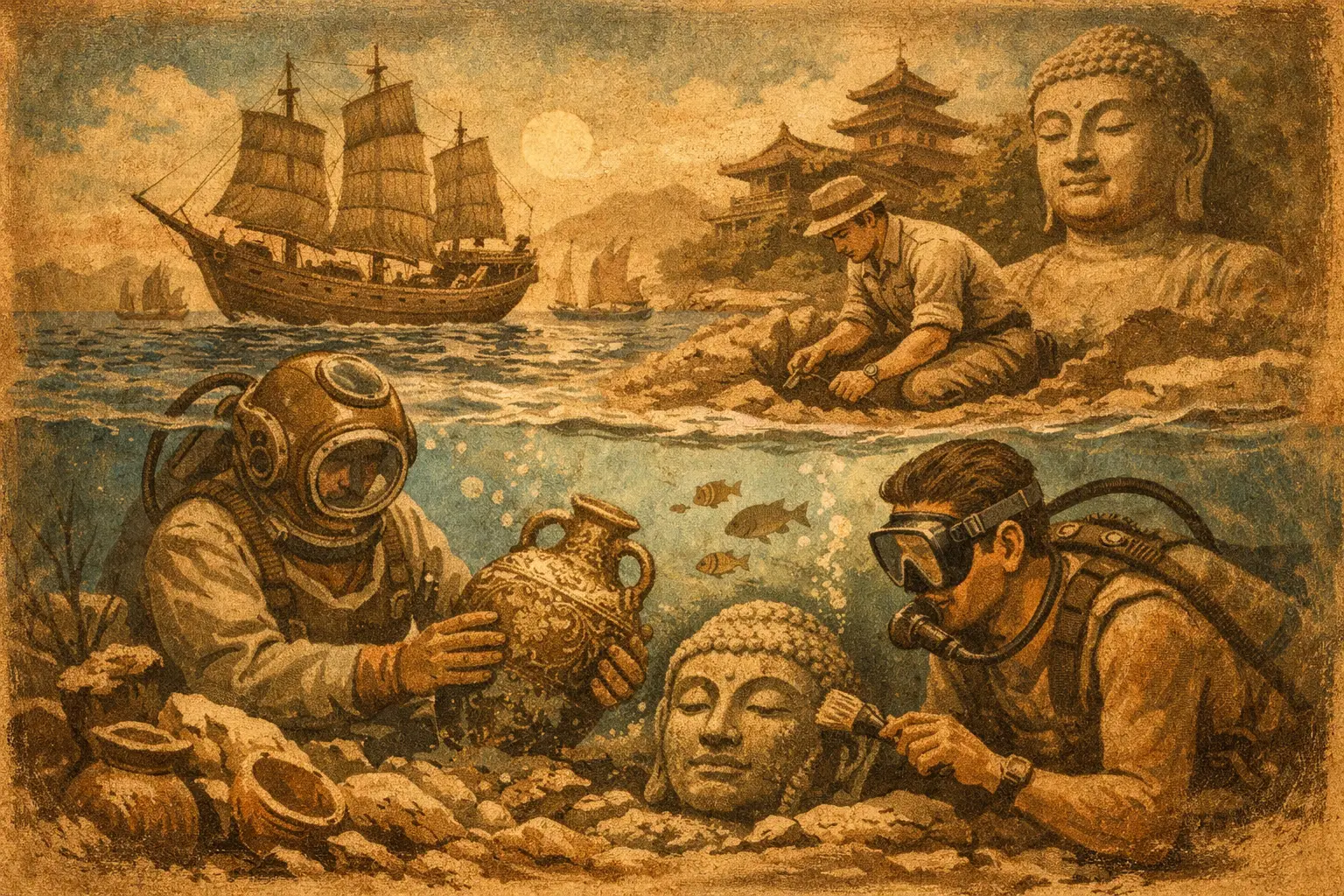

A bowl lifted from the seabed may appear modest at first glance. Yet its glaze, kiln mark and place among hundreds of other pieces can reveal a lost trading voyage, the tastes of distant buyers and the commercial reach of an empire. Maritime archaeology finds make the sea legible in this way: not as an empty divide between ports, but as a living route through which Asia exchanged ideas, skills, food, faith and extraordinary objects.
For visitors drawn to George Town’s layered past, shipwreck ceramics offer a particularly tangible encounter with that history. These vessels were made to travel. Their survival beneath the water gives us a rare record of what merchants considered valuable enough to carry across dangerous seas.
Why maritime archaeology finds matter
Land archaeology often tells us how people lived in a single place. A shipwreck tells a different kind of story. It captures a journey in progress, preserving a cargo assembled for a particular market at a particular moment. The wreck may contain thousands of ceramics, but it may also hold anchors, storage jars, coins, spices, tools and traces of the ship itself.
Together, these objects can answer questions that written records leave open. Which ports were connected? What forms of porcelain appealed to overseas households? How were fragile wares packed for a long voyage? Where did trade patterns change, and why?
Ceramics are especially eloquent because they are both durable and distinctive. The clay body, decoration, firing method and shape can help specialists identify a production region and approximate date. A blue-and-white dish, a celadon bowl or a brown-glazed jar is not simply decorative. It is evidence of technology, labour, fashion and exchange.
There is also a human dimension. A cargo was selected by merchants, loaded by sailors and intended for people who might never have seen the kilns where it was made. Every vessel represents a chain of decisions. When a ship sank, that chain was interrupted – then preserved for centuries.
Shipwreck ceramics and the Asian maritime world
The seas of Southeast Asia were among the world’s great commercial highways. Monsoon winds shaped sailing schedules, while ports across the Malay Archipelago linked China, India, the Middle East and beyond. Long before modern container shipping, these waters supported a sophisticated network of producers, brokers, sailors and consumers.
The porcelain carried aboard trading ships travelled far beyond the imperial courts often associated with fine Chinese wares. Everyday bowls, ewers, plates and jars reached homes, kitchens and ceremonial settings across the region. Their forms were sometimes adapted for export markets, proving that trade was not a one-way display of Chinese craftsmanship but a conversation between makers and buyers.
A cargo’s variety matters as much as its splendour. Fine pieces may suggest elite demand, while more practical wares point to broader consumption. Large storage jars speak of provisions and transport; smaller covered boxes and finely painted vessels can suggest gifting, dining or display. Archaeologists read these differences carefully, resisting the temptation to treat every object as a treasure detached from its original purpose.
What a single wreck can reveal
A well-documented shipwreck can provide an unusually precise snapshot of maritime life. If the vessel’s construction, cargo and recovery context are studied together, researchers can build a picture of its probable route, date and trading ambition.
The Wanli wreck, for example, is associated with the late Ming period, when export porcelain circulated widely across Southeast Asia. The Turiang, Royal Nanhai, Nanyang, Xuande and Desaru wrecks each add further chapters to this regional story. Seen side by side, their ceramics reveal changes in taste, manufacturing and trade over time rather than a single, fixed idea of Asian maritime commerce.
That comparison is one of the great pleasures of a specialist collection. A visitor can notice how a motif develops, how a vessel shape changes, or how a particular glaze catches the light differently from one era to another. History becomes visible not only in dates, but in the quiet details of craft.
The value lies in context, not just beauty
Shipwreck porcelain is undeniably beautiful, and that beauty has helped it become highly sought after by collectors. But maritime archaeology asks us to look beyond the individual object. A plate without a recorded origin may still be visually compelling; a plate recovered, catalogued and conserved as part of a known cargo has a much richer historical voice.
Context includes the object’s position in the wreck, its relationship to other cargo, the ship’s location and the methods used during recovery. This information helps distinguish careful archaeological work from the simple removal of objects from the sea. Once those relationships are lost, many of the most valuable questions become impossible to answer.
Conservation is equally demanding. Centuries underwater can leave ceramics stable in one sense, yet vulnerable once they are exposed to air and changing temperatures. Salt must be managed, surfaces examined and repairs approached with restraint. The aim is not to make an artefact look newly made, but to preserve its integrity while allowing its story to be understood.
For this reason, authenticity is more than a label. It is an ethical commitment to provenance, stewardship and honest interpretation. Visitors deserve to know not only that an object is old, but why it matters and what is known – or not known – about its journey.
Seeing porcelain as evidence of everyday life
The most memorable maritime archaeology finds do not always have the grandest appearance. A stack of bowls can reveal mass production on an impressive scale. A small jar can hint at food storage, medicine or ritual. A dish decorated with a familiar floral design may show how visual language crossed borders, adapting as it moved.
This perspective makes museum viewing more rewarding. Instead of asking only, “How much is this worth?”, try asking, “Who was this made for?” Consider its size, its wear, its decoration and the practical challenge of transporting it by sea. Was it designed for a formal table, a merchant household or a port community? Was it chosen because it was fashionable, functional, or both?
It depends on the evidence, and responsible interpretation leaves room for uncertainty. Maritime history is full of gaps: ships disappear, records are incomplete and coastlines change. Yet the surviving material culture is powerful precisely because it gives those gaps shape. It allows us to recognise patterns without pretending that every answer is final.
A journey through time in Penang
Penang’s own story has always been tied to the sea. Its position along historic trading routes makes it a fitting place to encounter the wider maritime world of Asia, where goods, people and ideas moved continually between shorelines.
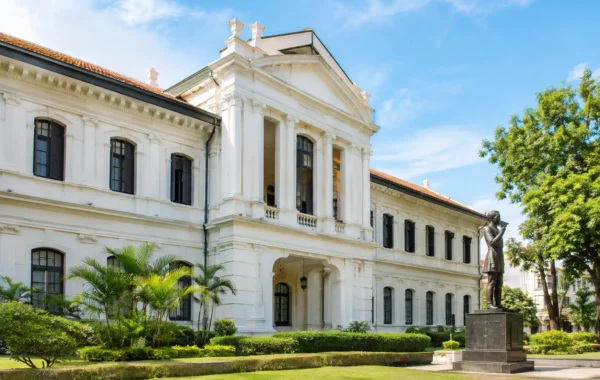
At Straits & Oriental Museum, authentic ceramics recovered from major Asian shipwrecks are presented as more than isolated antiques. They are invitations to consider the routes that connected distant kilns with Southeast Asian ports, and the remarkable skill required to create objects intended to endure both use and travel.
This is also where a heritage visit can become a fuller cultural outing. After spending time with the collections, visitors may carry the visual memory of a cobalt-blue motif or a luminous celadon glaze into the rest of their day in George Town. The past does not need to feel remote when it is encountered through objects made for human hands, tables and homes.
How to look more closely at maritime archaeology finds
Begin with the object’s form before its decoration. A wide dish, a deep bowl and a narrow-necked ewer each served different needs, and shape can offer clues to a vessel’s intended market. Then look at the surface: are the designs painted, carved, moulded or left deliberately plain? Small irregularities may reveal the hand of production or the practical realities of firing and transport.
Next, place the piece within its cargo. A single ceramic can be admired on its own, but a group of similar objects suggests scale, demand and a merchant’s strategy. Finally, ask what the object cannot tell us by itself. This modest question is often the beginning of deeper appreciation.
The next time you stand before shipwreck porcelain, allow yourself a little patience. Look past the gleam of the glaze and imagine the port, the hold, the monsoon crossing and the intended recipient. In that moment, the sea becomes less of a distance and more of a connection.