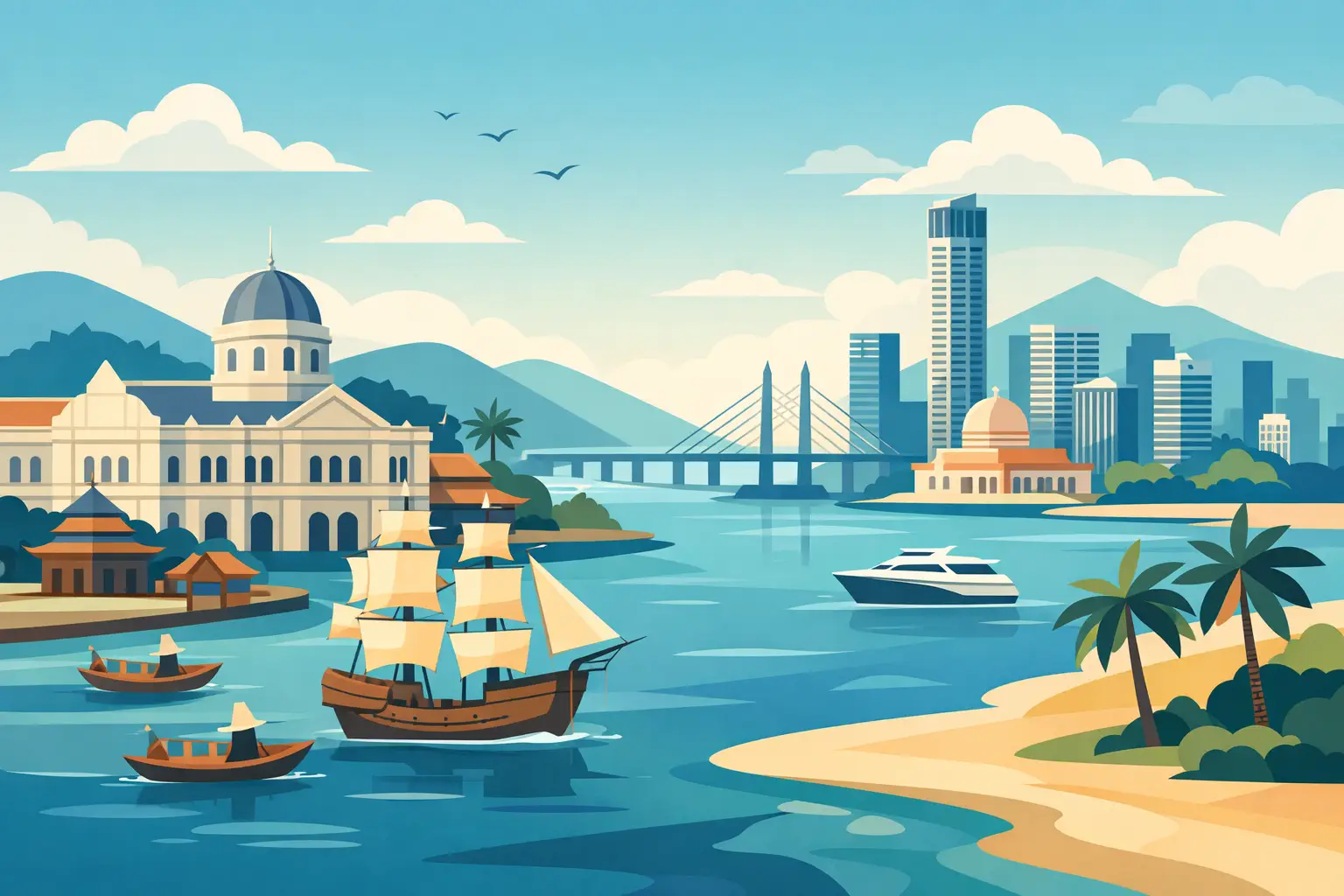

Few political arrangements left such a visible mark on Penang as The Straits Settlement. What began as an imperial framework for trade became something far more enduring – a maritime world shaped by movement, commerce, taste and cultural exchange. To understand Penang properly, you have to look beyond its streets and shophouses and out to sea.
That is where the real story starts. Ships carried tea, silk, spices, opium, textiles and ceramics across the region, but they also carried people, ideas, languages and habits of living. The Straits Settlement was not simply an administrative label. It was the structure behind one of Southeast Asia’s most important port networks, and Penang was one of its defining stages.
What was The Straits Settlement?
The Straits Settlement refers to the British colonial grouping of Penang, Malacca and Singapore, later joined for a period by Labuan. Established in the nineteenth century, it brought together key ports along strategic maritime routes linking the Indian Ocean with the South China Sea. This mattered because control of trade was never only about territory. It was about harbours, customs, warehousing, shipping lanes and the ability to move goods efficiently and profitably.
Penang’s importance within this system was immediate. Founded as a British trading post in 1786, it offered a practical anchorage in a region where maritime access determined power. By the time the Settlements were formalised, Penang had already become a place where Asian merchants, European agents and migrant communities converged. The British saw administrative order. Traders saw opportunity.
That distinction is worth keeping in mind. Colonial maps tend to flatten history into neat jurisdictions, but port cities rarely behave so tidily. The Straits Settlement gave structure to trade, yet the life of Penang came from the people and cargoes passing through it every day.
Why Penang mattered within The Straits Settlement
Penang did not become significant by accident. Its position along major sea routes made it useful to merchants sailing between India, China and the Malay world. It developed as a free port, which encouraged commerce by lowering barriers and attracting traders from different backgrounds. That policy helped turn the island into a lively and competitive marketplace.
Yet Penang’s role was not identical to Singapore’s, nor was it simply secondary. Singapore would eventually dominate in scale, but Penang had its own rhythm and regional reach, particularly in the northern Straits and the Bay of Bengal connections. It served as a commercial hinge between mainland Southeast Asia, the Indonesian archipelago, South Asia and China.
This meant Penang’s harbour was filled with more than imperial shipping. Chinese junks, Malay vessels, Indian traders and Arab merchants all played their part. The port’s wealth came from layered exchange, not from a single direction of influence. That is one reason Penang’s historical identity feels so richly textured even now.
Trade, porcelain and the culture of exchange
If you want to see the spirit of the Straits world in material form, look at ceramics. Porcelain moved across these sea lanes in astonishing quantities. Some pieces were made for elite households, others for daily use, and many were tailored for export markets with very specific tastes. Their survival tells us what people bought, valued, displayed and transported.
Ceramics are especially revealing because they sit at the meeting point of commerce and culture. A bowl or plate is never just an object of trade. It also reflects dining customs, status, household rituals and aesthetic preference. In a port society shaped by migration and mercantile ambition, such objects often became part of how communities expressed identity.
This is where maritime archaeology adds extraordinary depth. Shipwreck ceramics remind us that regional trade was vast, risky and deeply interconnected. Every recovered cargo tells a story interrupted by weather, conflict, navigation errors or misfortune. Yet those same losses now offer rare evidence of what moved through the Straits in different periods.
For visitors interested in Penang’s past, this matters because the island’s heritage was not built only on land. It was built through maritime circulation. The porcelain that survived beneath the sea is part of the same historical world that shaped the cosmopolitan character of the old port.
The social world created by the Settlements
The Straits Settlement was also a human story. Trade required labour, finance, translation, brokerage and trust. That brought together communities from across Asia and beyond, each contributing to the life of the port. Chinese merchants, Indian financiers, Malay seafarers, Eurasian families, Arab traders and European administrators all left their imprint.
In Penang, these encounters produced a distinctive urban culture. Foodways blended. Languages overlapped. Religious buildings rose within close reach of one another. Commercial success influenced domestic architecture, collecting habits and public life. The result was not harmony in every sense – port cities are often unequal, competitive and politically tense – but rather a sophisticated coexistence shaped by mutual dependence.
This helps explain why Penang cannot be reduced to a single narrative. It was British-administered, certainly, but never culturally singular. The settlements relied on local and regional networks they did not fully control. Their success rested on the participation of communities with their own priorities, traditions and ambitions.
The limits of the colonial frame
There is a temptation to treat The Straits Settlement as a story of efficient empire and rising prosperity. That reading is incomplete. Trade enriched ports like Penang, but colonial structures also concentrated power, redirected resources and entrenched hierarchies. Benefits were unevenly shared, and the system was built around imperial interests.
For modern readers, that complexity is essential. Heritage becomes far more meaningful when it includes both splendour and contradiction. The beautiful objects, grand mercantile houses and thriving port economy were real, but so were the asymmetries of colonial rule.
That does not diminish Penang’s achievement. If anything, it makes the island’s story more compelling. Penang’s communities did not simply receive history from above. They negotiated it, adapted to it and shaped a culture far richer than any official framework could define.
How the legacy still lives in Penang
The legacy of the Settlements is still visible in Penang’s built environment, collecting culture and public imagination. You see it in trading houses, clan buildings, religious landmarks and streetscapes formed by global commerce. You feel it in the island’s openness to influence and its confidence as a crossroads.
But some of the most powerful evidence survives in objects rather than architecture. Maritime artefacts, especially ceramics recovered from historic shipwrecks, reveal the trade routes that sustained the region and the tastes that flourished within it. They also give visitors something rare – a direct material link to the sea-based world that made Penang possible.
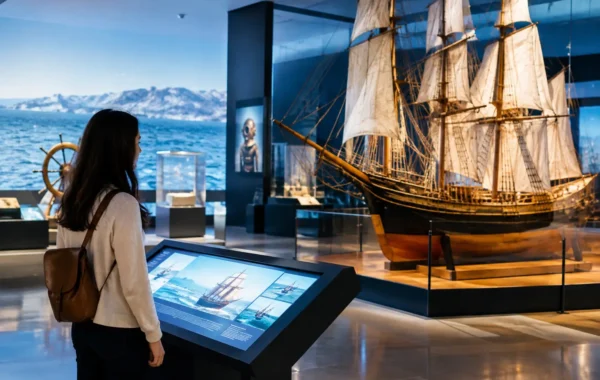
This is why a thoughtfully curated heritage experience can transform abstract history into something immediate. When porcelain from lost vessels is presented not as isolated treasure but as part of a wider maritime narrative, the story of Penang and the Straits becomes vivid. You are no longer reading about trade. You are standing before its remains.
At Straits & Oriental Museum, that perspective feels especially resonant. The museum’s focus on authentic shipwreck ceramics and maritime storytelling offers a striking way to understand the port city beyond its surface beauty. It restores the sea to the centre of the conversation, where it belongs.
Why The Straits Settlement still matters today
The phrase may sound historical, but its significance is not confined to the past. The Straits Settlement helps explain why Penang became a place of exceptional cultural density, commercial sophistication and international character. It also reminds us that globalisation is not new here. The island has long been shaped by circulation – of goods, people, belief and style.
For travellers, collectors and heritage-minded visitors, this gives Penang a different kind of appeal. It is not merely picturesque. It is evidence of a maritime civilisation in motion. The best way to appreciate that inheritance is to look closely at what survived – the port, the communities, the architecture and the porcelain that crossed dangerous waters to reach these shores, or never quite did.
That is perhaps the most fascinating truth of all. The story of the Straits is not just in what arrived safely, but in what was lost at sea and found again centuries later, still carrying the memory of a world built on trade, taste and human passage.