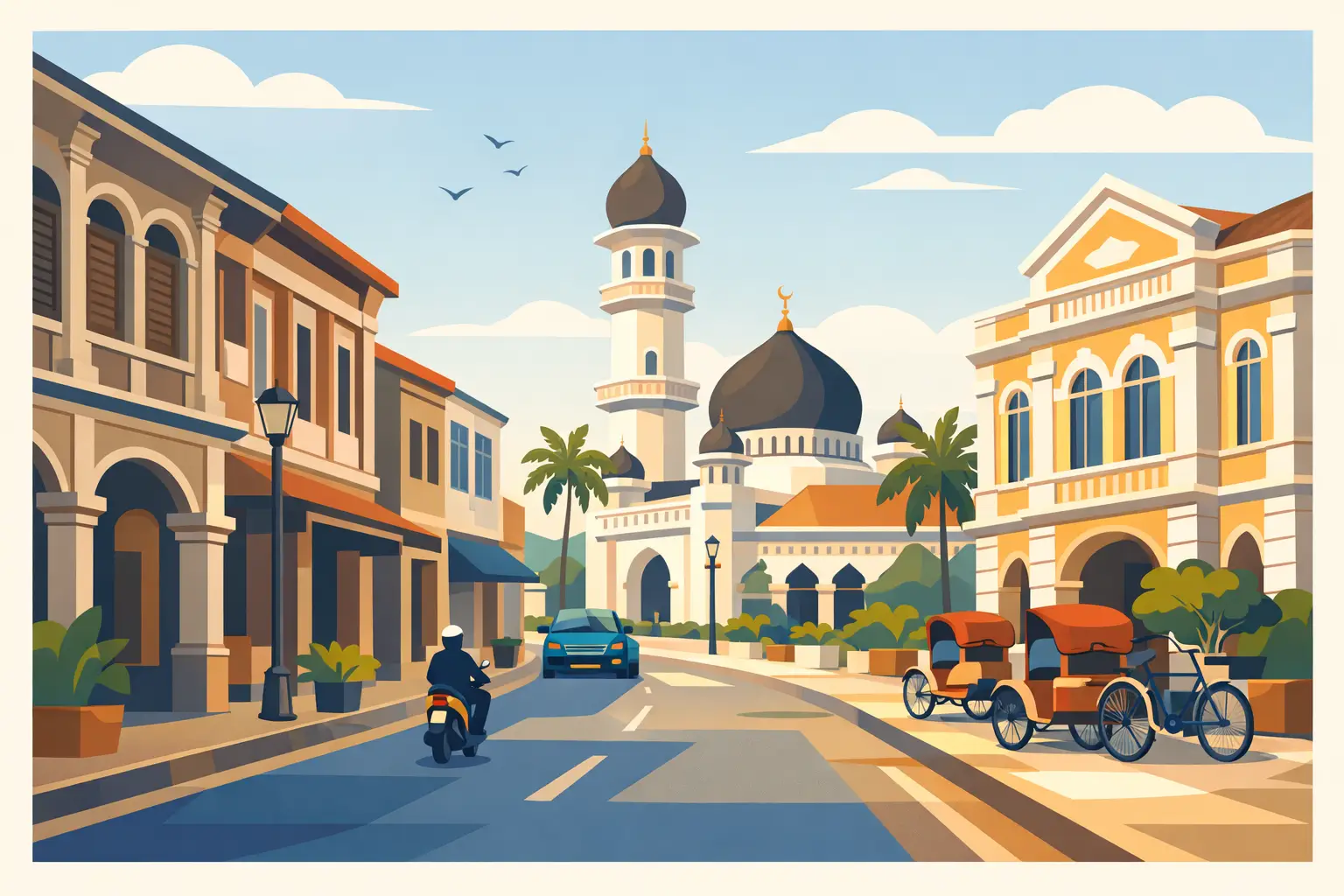

A street can tell you what a port city valued. On Church Street at Georgetown Penang, that story is written in trading houses, colonial-era facades, civic landmarks and the quiet confidence of a neighbourhood that once stood at the heart of regional commerce. This is not merely a pleasant heritage street to stroll for photographs. It is one of the clearest places in George Town to understand how belief, business, migration and maritime exchange shaped Penang into a historic entrepot.
For visitors who want more than a checklist of sights, Church Street rewards close attention. The architecture is handsome, certainly, but the deeper appeal lies in how the street gathers layers of Penang’s identity into one walkable stretch. You see institutions of faith near former mercantile premises, administrative grandeur beside lived urban texture, and the unmistakable imprint of a city built by movement across the sea.
Why Church Street at Georgetown Penang matters
Many streets in George Town are attractive. Fewer feel so firmly tied to the city’s larger historical importance. Church Street sits within the old colonial core, where commercial ambition and imperial administration once met the practical realities of shipping, warehousing and international trade. When travellers speak of George Town as a UNESCO-listed destination, this is the sort of streetscape they have in mind – elegant yet functional, historic yet still legible as part of a living city.
The name itself points to one dimension of the area’s past, but the street’s significance extends far beyond religion. It formed part of a network that connected harbour activity, merchant communities and institutional power. In a place like Penang, that relationship matters. The island’s story was never only local. It was shaped by vessels arriving with goods, ideas, craftsmen, officials and families from across Asia and beyond.
That is why Church Street feels especially resonant for visitors interested in maritime history. Even when you are not standing on the waterfront itself, the sea is present in the logic of the built environment. The grander buildings, the commercial addresses and the urban planning all reflect a city oriented towards shipping routes and mercantile exchange.
What you notice first on Church Street at Georgetown Penang
The first impression is usually one of proportion and poise. This is a street of dignified facades, shuttered windows, arcades and period details that hold their own without theatricality. Unlike heritage zones that feel overly staged, Church Street often retains a more grounded atmosphere. It still reads as part of a real city, not a preserved backdrop.
That balance is part of its charm. Some visitors expect every heritage street to be crowded with cafés and souvenir frontage. Church Street can be more restrained. The reward is a clearer sense of urban history. You are able to look up, notice masonry and ornament, and take in the rhythm of old commercial architecture without too much visual noise.
There is also a certain formality here. The buildings project status because many were designed to do exactly that. Merchants, administrators and institutions used architecture to communicate permanence, reliability and influence. In a competitive port environment, appearance mattered. A facade was not decorative fluff. It was a statement of standing.
A street shaped by trade, faith and administration
To understand Church Street properly, it helps to see it as an intersection of three forces. The first was trade. George Town rose through maritime commerce, and streets close to the historic port were naturally drawn into that system. Offices, godowns, counting houses and associated services grew where they were most useful.
The second was faith. Penang’s development brought together diverse communities, and religious institutions became visible anchors within the city. They offered continuity in a changing colonial port and reflected the social worlds that migrants built for themselves. On Church Street and the surrounding area, these echoes remain part of the district’s identity.
The third was administration. Colonial cities tend to leave behind an architectural language of order – courthouses, government buildings, municipal structures and disciplined streetscapes. Church Street carries that legacy with unusual clarity. It is one reason the area feels more stately than some of the narrower, more intimate lanes elsewhere in George Town.
Taken together, those three forces created a district that speaks in several registers at once. It is commercial but not only commercial, ceremonial but not solely monumental. That complexity gives the street its staying power.
How to experience the street well
The best way to approach Church Street is slowly and at a time of day when the light allows the buildings to show their texture. Early morning has a particular grace, with softer shadows and less traffic. Late afternoon can also be rewarding, especially for visitors who enjoy a warmer tone across stucco, timber shutters and five-foot ways.
Rushing through is the most common mistake. Because the street appears relatively straightforward, people sometimes treat it as a corridor between better-known stops. It deserves more patience than that. Pause at corners. Look above ground level. Notice where grand public architecture gives way to commercial frontage. The transitions tell you as much as the landmarks themselves.
It also helps to pair the walk with a broader interest. If you care about architecture, Church Street offers composition, proportion and material detail. If you care about social history, it reveals how institutions and businesses occupied space. If you are drawn to maritime heritage, the area makes more sense when read as part of an old port ecosystem.
That last perspective is especially rewarding in George Town. A visit to a heritage institution such as Straits & Oriental Museum can deepen that experience by placing urban history in the wider context of seaborne exchange, shipwreck discoveries and the circulation of ceramics across Asia. Streets like this did not flourish in isolation. They were linked to vessels, cargoes and commercial worlds far beyond the island.
What makes this part of George Town different
Not every heritage area in Penang offers the same atmosphere. Some streets are animated by food culture, murals or small-scale residential charm. Church Street is different. Its strength lies in civic weight and mercantile memory. It feels closer to the machinery of the historic city – where decisions were made, fortunes built and authority displayed.
That does not mean it is severe. Rather, it has a composed quality that appeals to travellers looking for cultural depth. For couples, museum-goers and thoughtful visitors, that can be far more memorable than a hurried hunt for the most photographed corner.
There is, however, a trade-off. If you are seeking a highly animated street packed with casual browsing and constant activity, Church Street may feel quieter than expected. Yet for many visitors, that is precisely its value. It creates room to observe, interpret and imagine the city that once functioned here at full commercial force.
Architecture as evidence
One of the pleasures of Church Street is that the buildings do not merely decorate the past – they document it. Their scale, ornament and layout reflect the ambitions of the people and institutions that commissioned them. In port cities, architecture often becomes a record of confidence. When trade is strong, facades grow more refined. When administration consolidates, buildings become more declarative.
On this street, you can read those signals in masonry, columns, verandahs and long-fronted commercial premises. Even where use has changed over time, the original intent often remains visible. That continuity gives the area unusual interpretive value for visitors who enjoy heritage not as nostalgia, but as physical evidence.
It is also a reminder that George Town’s significance was never confined to charming domestic streets alone. The city prospered through systems – shipping, warehousing, law, finance, religion and governance. Church Street offers a particularly elegant view of that infrastructure.
A worthwhile stop for culturally curious travellers
For first-time visitors to Penang, Church Street works best as part of a day shaped by curiosity rather than speed. It suits those who enjoy moving between architecture, museums, galleries and places to pause over coffee or a leisurely meal. The area lends itself to that rhythm because it carries both historical gravity and the wider pleasures of being in George Town.
Families can appreciate the open-ended nature of the walk, especially if they prefer heritage experiences that do not feel overly academic. History enthusiasts will find more than enough to study in the streetscape itself. International visitors often respond to how clearly the district communicates Penang’s cosmopolitan past without needing excessive explanation.
Collectors and design-minded travellers may notice something else – the visual discipline of old mercantile architecture has its own quiet luxury. There is refinement here, but it is rooted in function and trade rather than showmanship. That sensibility feels entirely appropriate in a city whose fortunes were tied to goods moving across the sea.
Church Street is best appreciated as an invitation to look more carefully at George Town itself. Walk it with time, and the street stops being a backdrop. It becomes a key to the city.