
A porcelain bowl can survive centuries beneath the sea, yet still carry the mark of the hand that made it. That remarkable continuity sits at the heart of 海峡与东方博物馆 (Straits & Oriental Museum) as the centre for Chinese ceramics and works of art: a place where objects recovered from Asian shipwrecks return to view with their beauty, trade histories and human stories intact.
For visitors to George Town, this is not simply an opportunity to admire antique ceramics behind glass. It is a chance to understand how Chinese porcelain travelled across the seas, shaped tastes far beyond its kilns, and became part of the shared cultural history of Southeast Asia. Each vessel offers a close encounter with a world connected by monsoon winds, merchant routes, port cities and a lasting appetite for craftsmanship.
Chinese ceramics seen through the sea
Chinese ceramics are often discussed through dynasties, kiln sites and imperial taste. Those are essential reference points, but shipwreck collections offer another compelling perspective: what was made for movement. Cargo ceramics were selected, packed and transported because they were desired in homes, trading houses and courts across Asia and beyond.
A shipwreck therefore preserves a rare snapshot of commerce. Its cargo may reveal which forms were popular, which decorative styles travelled well, and how Chinese makers responded to customers in distant markets. A blue-and-white dish, a celadon bowl or a finely glazed jar is more than an attractive object. It is evidence of a sophisticated trade network that linked producers, sailors, merchants, patrons and collectors over vast distances.
The sea also changes how these objects are encountered. Time underwater can leave mineral traces, marine encrustation and subtle surface changes. Rather than diminishing their value, these marks often heighten their presence. They are physical reminders that every surviving piece has made an extraordinary journey before arriving in a museum setting.
Straits & Oriental Museum as a centre for Chinese ceramic art
Straits & Oriental Museum presents Chinese ceramic art as part of a wider maritime story, rather than isolating it from the routes that carried it into the region. This approach gives the collection an immediacy that appeals to both experienced collectors and first-time visitors. One can appreciate the balance of a porcelain form, the confidence of a painted motif or the finesse of a glaze, while also asking where it was bound and whose table it may have reached.
The museum’s permanent displays centre on authentic artefacts recovered from notable Asian shipwrecks, including the Wanli, Turiang, Royal Nanhai, Nanyang, Xuande and Desaru wrecks. Together, these collections document different moments in maritime exchange and bring a breadth of material that is difficult to grasp from a single object or period alone.
For collectors, provenance is a central part of the appeal. An object’s historical context matters as much as its visual character. Shipwreck ceramics carry a distinctive form of provenance: they belong to a defined maritime event, connected to a vessel, a route and a period of trade. That does not make every piece identical in rarity or significance – condition, form, decoration, age and historical context still matter greatly – but it does give visitors a clearer framework for understanding why these works deserve careful attention.
From imperial craft to everyday exchange
One of the most rewarding aspects of Chinese export ceramics is the way they bridge extraordinary craft and daily life. Porcelain was admired for its luminous whiteness, durable body and refined decoration, but it was also used. Dishes served food, jars stored goods, bowls passed between hands, and vessels marked occasions both ordinary and ceremonial.
This dual identity makes ceramic art unusually approachable. A visitor does not need specialist knowledge to respond to the quiet elegance of a celadon glaze or the narrative energy of cobalt-blue decoration. Yet closer looking reveals layers of technical and cultural sophistication. The choice of clay, firing temperature, glaze, painted imagery and vessel shape all speak to a tradition developed over centuries.
Export wares also challenge the idea that Chinese ceramics were created only for a single audience. Many pieces were made with overseas buyers in mind. Shapes, motifs and quantities could reflect the preferences of markets across Southeast Asia, the Indian Ocean and Europe. This is where the museum’s maritime focus becomes especially valuable: it shows Chinese art not as a closed tradition, but as an influential force in a long conversation between cultures.
What to look for when viewing shipwreck ceramics
The pleasure of a museum visit deepens when visitors slow down. Instead of moving quickly from case to case, begin with the silhouette of a vessel. Is it a bowl designed for repeated use, a jar suited to storage, or a plate made to display food? Form often offers the first clue to function and market.
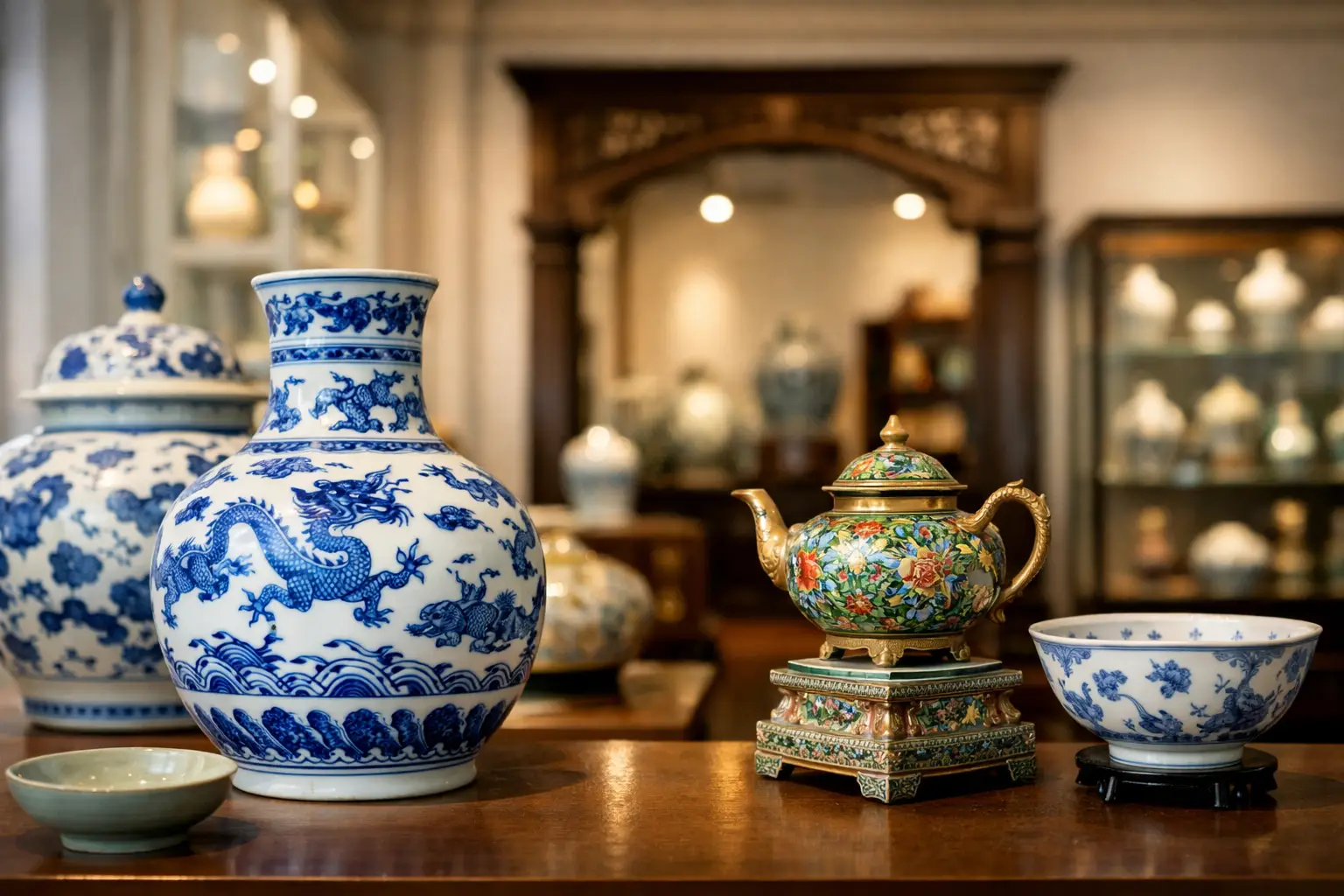
Then look at the surface. Blue-and-white porcelain may feature floral scrolls, landscapes, birds or auspicious symbols, while celadon draws the eye through its restrained green glaze and sculpted detail. Notice whether the decoration is spontaneous or formal, dense or spare. A small irregularity can be as revealing as a flawless finish, showing the realities of hand production and high-temperature firing.
Finally, consider the object as cargo. It was once one item among many, carefully packed for a dangerous sea crossing. That thought transforms the encounter. A plate becomes part of a merchant’s calculation, a sailor’s voyage and a port’s commercial life. The museum experience lies in bringing these connected stories into view without losing sight of the object’s simple visual power.
A cultural outing beyond the display case
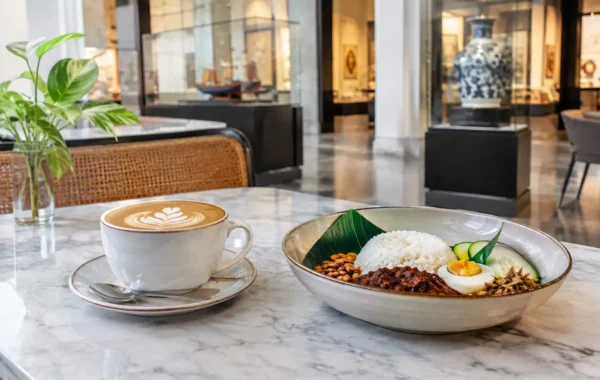
As Malaysia’s first integrated heritage and lifestyle museum, Straits & Oriental Museum makes room for a fuller kind of cultural visit. The experience extends beyond the galleries into art, exhibitions, dining, refreshments and considered retail. This matters because heritage is not best treated as something remote or solemn. It can be absorbed through conversation, curiosity and time well spent in a setting designed for discovery.
For travelling couples, the museum offers a distinctive pause from the usual itinerary. Families can find an accessible route into history through objects that are immediately visual and story-rich. For international visitors, it provides a meaningful introduction to Penang’s position within the maritime networks that shaped the region. And for those with a serious interest in antiques, it is a place to study the relationship between beauty, material culture and collecting.
The setting also encourages visitors to reflect on what museums can be. A strong museum does not merely hold objects. It gives them enough context to become vivid again. Here, porcelain does not sit silently as an isolated treasure; it speaks of workshops, ships, storms, markets, voyages and the enduring desire to make beautiful things.
Why this collection matters in Penang
Penang’s heritage has always been connected to the movement of people, ideas and goods. Its historic streets, food culture and trading past make it a natural home for a museum devoted to maritime archaeology and Chinese ceramics. The collection adds a tangible dimension to that wider history, showing the material objects that once moved through the same interconnected world.
There is also a wider regional significance. Southeast Asia was not simply a destination at the edge of Chinese trade. It was an active meeting ground where goods were exchanged, cultural preferences developed and maritime communities flourished. The ceramic cargoes represented in the museum help make that role visible.
For visitors, the value is not only academic. It is the rare pleasure of standing before a work that has crossed both ocean and time. The finest way to experience the galleries is to give each piece a moment: look closely at its surface, imagine its voyage, then allow its story to change how you see the sea beyond Penang’s shore.