
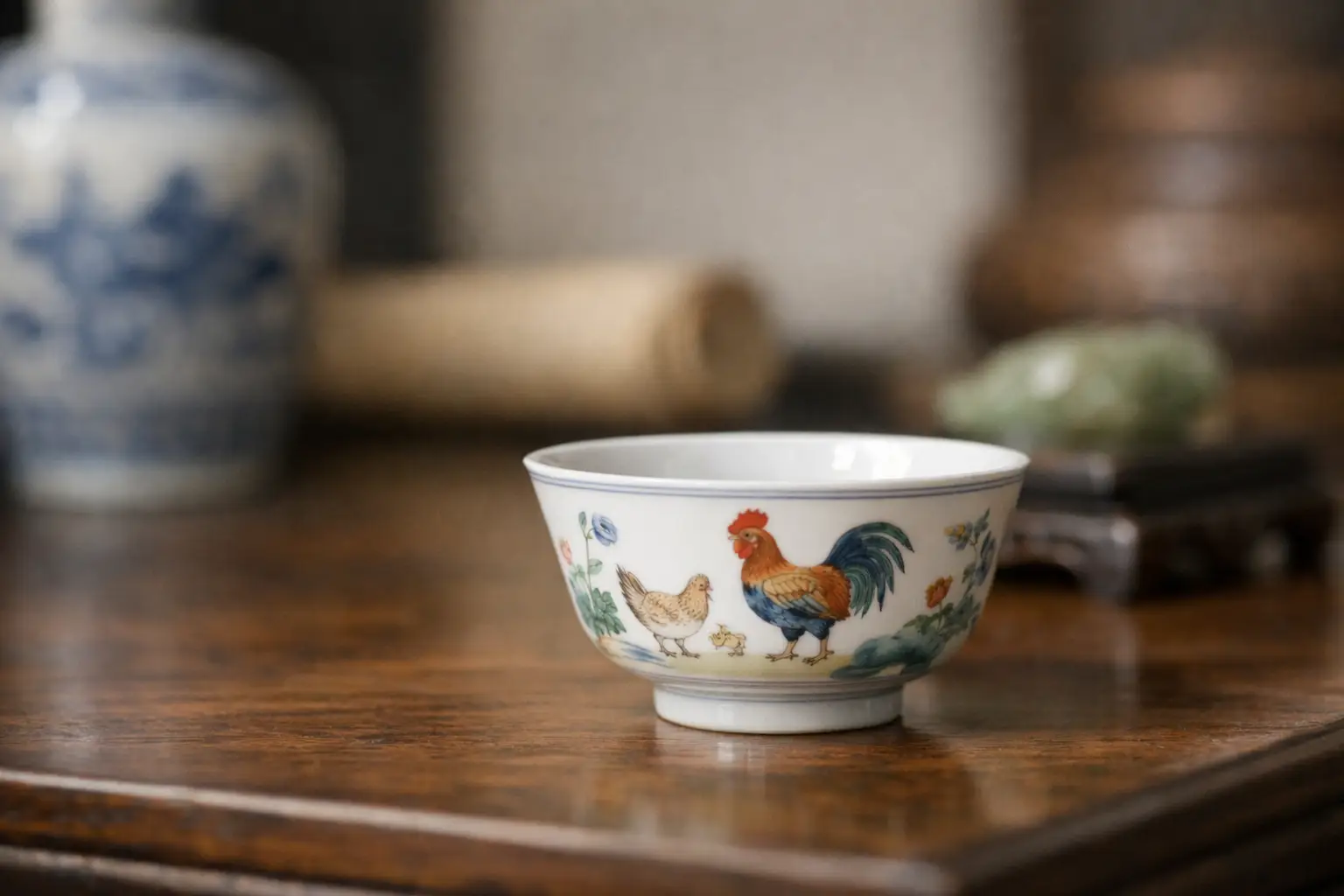

In 2014, a tiny porcelain cup painted with a family of chickens achieved more than HK$281 million at auction. The Ming dynasty Chicken Cup is among the most celebrated objects in Chinese ceramic history, not because of its size, but because it brings together imperial patronage, remarkable technical skill and a disarmingly intimate view of life.
For visitors and collectors, its appeal lies in this contrast. Here is a vessel small enough to rest in one hand, yet it carries the ambitions of the Ming court and the accumulated reverence of centuries. Its gentle hens, proud cockerels and wandering chicks have become an enduring image of refined Chinese taste.
What is a Ming dynasty Chicken Cup?
The name generally refers to the Chenghua-period chicken cup, made during the reign of the Chenghua Emperor between 1465 and 1487. It is a small, thinly potted porcelain wine cup, most often associated with the imperial kilns at Jingdezhen, the great centre of Chinese porcelain production.
Its decoration is instantly recognisable. On the exterior, a cockerel, hen and chicks move through a garden setting, accompanied by rocks and flowering plants. The scene is neither grand nor ceremonial. Instead, it feels observant and tender, a miniature domestic world painted with extraordinary control.
The cup was created in doucai, a demanding decorative method often translated as “contrasting colours”. Craftsmen first painted the principal outlines in cobalt blue beneath the glaze and fired the porcelain at a high temperature. They then added coloured enamels over the glaze and fired it again at a lower temperature. The result is unusually soft and precise: blue lines give the design definition, while translucent green, yellow, red and aubergine enamels bring it to life.
This restrained palette matters. Later Chinese porcelain can be lavishly decorated, but the Chicken Cup’s beauty comes from balance. Its colours are clear rather than loud, its composition spacious rather than crowded, and its painting full of character without becoming sentimental.
Why the Chicken Cup became an imperial icon
Chenghua porcelain has long been admired for its delicacy. The emperor’s reign was marked by a preference for finely made, intimate objects rather than monumental display, and the Chicken Cup perfectly expresses that sensibility. Its walls are light, its foot is neat and its painted story rewards close looking.
The chicken family also carried auspicious associations. In Chinese visual culture, the cockerel could evoke success and rank, while hens and chicks suggested domestic harmony, fertility and continuity across generations. Such meanings would have made the design suitable for an imperial household, where even a wine cup could communicate wishes for prosperity and flourishing descendants.
Yet symbolism alone does not explain its stature. Many Ming ceramics feature auspicious motifs. The Chicken Cup stands apart because its imagery feels animated. The rooster appears alert, the hen protective, and the chicks delightfully absorbed in their surroundings. It is porcelain with a pulse.
The quiet difficulty behind its making
A Chicken Cup may look effortless, but it was anything but. Jingdezhen porcelain required carefully prepared clay, exact firing conditions and a close understanding of how pigments behaved in the kiln. A slight flaw in the body, glaze or enamel could compromise the finished piece.
Doucai decoration added another layer of risk. The cobalt outlines had to remain crisp beneath the glaze, while the overglaze enamels needed to sit comfortably within them after a second firing. This was not a process that rewarded haste. The successful cup depended on coordination between potter, painter, kiln worker and workshop supervisor.
The Chenghua examples are especially admired for their fine porcelain body, warm glaze and subtle painting. Authentic early examples do not have the hard, uniform look sometimes associated with later decorative copies. Their charm is in their nuance: a gently uneven hand-drawn line, a softened enamel edge, a slight variation in colour where the material and firing have done their work.
Why original Chicken Cups are so rare
The world’s great museums and leading private collections hold only a small number of recognised Chenghua Chicken Cups. Their survival is remarkable. They were made for an imperial environment, used as precious drinking vessels, then passed through turbulent centuries of dynastic change, collecting and trade.
Their fame has also encouraged imitation. Copies were made in later Ming reigns, under the Qing dynasty and into the modern era. Some were created as homage to Chenghua taste; others were intended to satisfy a growing market for antiquities. A later copy can itself be historically interesting and beautifully made, but it is not the same as a fifteenth-century imperial original.
This distinction is central to value. The celebrated 2014 auction result reflected far more than an attractive painted cup. It reflected rarity, imperial origin, exceptional condition, documented provenance and the object’s place in the history of collecting. Auction figures can be dramatic, but they should never be treated as a shortcut to judging an artefact.
How specialists read a Chicken Cup
No single feature proves authenticity. Specialists assess the object as a whole, comparing the porcelain body, glaze, foot rim, cobalt drawing, enamel palette, style of painting and signs of age against established examples. Provenance and publication history can be just as significant as visual examination.
A convincing Chicken Cup should show a coherent relationship between form and decoration. The cup’s proportions need to feel right; the scene should follow the known Chenghua language without looking mechanically copied; and the enamels should have depth rather than a modern, overly glossy appearance. Even then, serious assessment calls for experience, close physical inspection and, where appropriate, scientific analysis.
Condition also deserves careful attention. Hairline cracks, restored areas, worn enamels and altered foot rims can substantially affect both historical integrity and market value. There is no universal rule that an old repair makes an object unworthy – preservation history can be part of an artefact’s story – but transparency is essential.
For a collector, the sensible starting point is not the hope of finding a forgotten Chenghua original. It is learning to see well. Study reliable examples, handle ceramics whenever possible, ask clear questions about condition and provenance, and seek independent expertise before making a significant purchase. The market rewards knowledge, but it can punish assumptions.
A cup that tells a wider story of Asian porcelain
The Chicken Cup also belongs to a larger maritime history. Porcelain made at Jingdezhen travelled through courts, ports and trading networks across Asia and beyond, becoming both a luxury commodity and a marker of cultural exchange. While an imperial Chicken Cup was not an everyday export vessel, its technical brilliance helps explain why Chinese ceramics commanded such admiration across the region.
At Straits & Oriental Museum, shipwreck ceramics offer a complementary way to encounter that wider story. Objects recovered from maritime routes reveal how bowls, jars and dishes moved between producers, merchants and distant communities. They remind us that porcelain was never merely decorative. It was carried across seas, selected for use, valued in homes and preserved in the seabed until its recovery centuries later.
Seen in this context, the Chicken Cup is not simply a record-breaking treasure. It is evidence of a civilisation in which artistry, material knowledge and social meaning could be held within a single small object. Look closely at the painted chicks and the measured sweep of cobalt line, and the cup begins to feel less like a distant masterpiece than a remarkably human work of art.