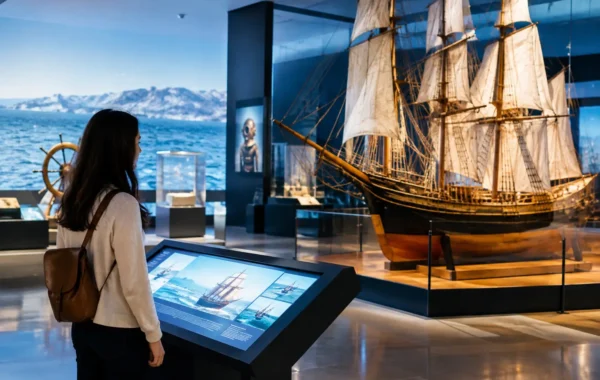

Most museum visits begin with a label and a display case. A true maritime heritage experience begins much earlier – with trade winds, port cities, lost cargoes and the quiet shock of seeing an object that has crossed centuries to meet you face to face.
That difference matters. Maritime history is not only about ships or sea routes. It is about movement – of people, ideas, craftsmanship, wealth and taste. When presented well, it becomes one of the most vivid ways to understand how a place came to be. For visitors seeking more than a conventional gallery walk, a maritime heritage experience offers something richer: the chance to encounter history as a lived exchange between cultures, commerce and memory.
What a maritime heritage experience should feel like
The best heritage experiences do not simply present facts. They create atmosphere, perspective and emotional connection. In a maritime setting, that often begins with objects carrying visible traces of travel and survival. Porcelain and ceramics recovered from historic shipwrecks are especially powerful because they were never made to be museum pieces. They were made to be used, traded, gifted and transported across seas.
That gives them a rare authority. A bowl, dish or vase from a shipwreck tells two stories at once – the story of where it was made, and the story of where it was going. In that gap between origin and destination lies the drama of maritime history. Visitors do not need specialist knowledge to feel it. They can see the delicacy of the glaze, the precision of the form and the improbability of its survival.
A strong maritime heritage experience should also feel grounded in place. Ports are not abstract concepts. They shape cuisines, architecture, collecting traditions and civic identity. In a destination with deep trading connections, maritime heritage is not a side note to local history. It is one of the central forces that formed the character of the place.
Why shipwreck ceramics hold such fascination
Not every historic object has the same power to stop people in their tracks. Shipwreck ceramics do, partly because they combine beauty with suspense. They emerge from the sea carrying an aura that is both archaeological and deeply human. These were cargoes in motion, interrupted by weather, misfortune or conflict, and preserved in silence for generations.
There is also the matter of scale. A written archive may explain trade patterns, but a cargo assemblage shows them materially. Through porcelain, visitors can grasp the sophistication of regional commerce, the appetite for luxury goods and the technical excellence of ceramic production across Asia. A single recovered piece may suggest a wider network linking kilns, merchants, ports and households across enormous distances.
For collectors and design-minded visitors, the appeal can be even more immediate. These objects are refined. Their patterns, proportions and surfaces still feel elegant now. Yet their beauty is inseparable from their historical journey. That is what sets them apart from decorative display. They are evidence as much as art.
Beyond display cases: the importance of storytelling
A museum can own remarkable artefacts and still fall short if it presents them without narrative. The difference between seeing a ceramic plate and understanding its significance lies in curation. Context turns a rare object into a memorable encounter.
That means explaining where an artefact came from, which vessel carried it and why that cargo mattered. It means giving visitors a sense of the era that produced it – the ambitions of trade, the craftsmanship of ceramic centres, the risks of long-distance passage and the cultural appetite that drove demand. Good storytelling does not flatten complexity, but it also does not bury visitors under academic language.
This balance is especially important for families and international travellers. They want depth, but they also want clarity. The strongest experiences welcome first-time museum-goers while still rewarding seasoned enthusiasts. A child may be captivated by the idea of treasure from a shipwreck, while a collector may linger over kiln characteristics, dating and provenance. Both should feel addressed.
The maritime heritage experience as a full cultural outing
There is a reason the most memorable cultural destinations no longer rely on exhibition alone. Visitors increasingly want their time to feel complete. They may begin with history, but they also want space to reflect, dine, browse and continue the conversation.
This is where an integrated approach becomes especially compelling. A maritime heritage experience can extend beyond the gallery into a broader atmosphere of discovery and leisure. After viewing shipwreck ceramics and learning the stories behind them, visitors often want to sit with that sense of wonder. Food, coffee, conversation and beautifully considered surroundings help history stay present rather than ending at the exit.
That does not mean heritage should be diluted into entertainment. Quite the opposite. When done with care, hospitality can deepen engagement. A thoughtfully designed cultural destination allows visitors to move between learning and enjoyment without feeling that one diminishes the other. The trade-off is subtle but important: if the lifestyle element overwhelms the historical core, the experience loses credibility. If the historical presentation is too static, many visitors will admire it without truly connecting.
The ideal balance is one in which scholarship gives the experience authority and contemporary hospitality gives it warmth.
What visitors remember most
People rarely remember every date or dynasty. They remember how a place made them feel and which details stayed with them on the journey home. In maritime heritage, those details tend to be wonderfully specific: a porcelain shard transformed into a complete story, a recovered cargo linked to a known shipwreck, a pattern that travelled across seas, a gallery moment that suddenly makes an old trading world feel present.
They also remember surprise. Many visitors arrive expecting a niche historical subject and leave realising that maritime heritage touches design, diplomacy, migration, collecting and everyday life. It is expansive by nature. The sea connected worlds long before modern tourism did.
This is particularly true in George Town, where maritime history is not distant theatre but part of the city’s wider historical fabric. A museum that treats this legacy with confidence and elegance can offer more than information. It can offer orientation – a way of understanding why the region developed the way it did, and why certain objects still carry such prestige.
How authenticity shapes trust
For discerning visitors, authenticity is not a slogan. It is the foundation of value. Original artefacts, responsible interpretation and clear provenance all matter. In maritime archaeology, that standard is especially important because the subject easily attracts romanticism. Romance has its place, but it must be anchored by evidence.
This is where institutional authority becomes meaningful. When visitors know they are viewing authentic porcelain and ceramic artefacts recovered from documented Asian shipwrecks such as the Wanli, Turiang, Royal Nanhai, Nanyang, Xuande and Desaru, the experience gains weight. It moves from themed attraction to cultural landmark.
For some, that authority is what justifies a dedicated visit. For others, it is what turns a pleasant stop into a highlight of their time in Penang. Straits & Oriental Museum stands apart precisely because it presents this material not as a minor annex to local history, but as a central story of regional significance and visual splendour.
A maritime heritage experience for different kinds of visitors
One of the strengths of this subject is its reach. Couples may come for a refined afternoon with cultural depth. Families may come because shipwrecks and treasure still ignite curiosity across generations. History enthusiasts may come for the rare chance to see maritime trade interpreted through tangible cargo rather than textbooks alone. Collectors may come with a sharper eye, looking closely at ceramic quality, rarity and historical importance.
Each visitor takes something slightly different from the experience. That is a strength, not a weakness. Heritage that only speaks to specialists risks becoming closed. Heritage that tries to please everyone with superficial spectacle risks becoming forgettable. The most successful maritime heritage experience respects both intelligence and curiosity.
Why this kind of experience matters now
There is a growing appetite for cultural destinations that feel meaningful rather than generic. Travellers want places with a real sense of provenance. They want stories that belong where they are being told. Maritime heritage answers that need with unusual force because it links local identity to wider regional and global histories.
It also offers a corrective to the speed of modern travel. To stand before an object carried across seas centuries ago is to be reminded that exchange once depended on patience, skill and risk. That perspective can be quietly moving. It invites visitors to slow down and consider how fragile, ambitious and interconnected human history has always been.
A memorable maritime heritage experience does not ask visitors merely to observe the past. It invites them to recognise how trade, taste and travel continue to shape the world around them. If you leave with a stronger sense of place, a sharper eye for craftsmanship and a lingering curiosity about the stories hidden inside beautiful objects, the experience has done exactly what great heritage should.